The Syrian Powder Keg – II

Things just got a little more interesting in Syria this week on several fronts:  1.) Word came out from a 200 page confidential UN report that North Korea has been providing the Syrians with materials needed for chemical and ballistic weapons production over the last five years, 2.) Iran has reportedly built a new airbase on the outskirts of Damascus, complete with two new hangars, roughly 60′ x 90′, plenty large enough for housing missiles capable of hitting Israel; and, 3.) Russia, according to General Joseph Votel, is playing “both arsonist and fireman.”

As for North Korea’s involvement in Syria:  According to the UN report, a Chinese trading company, Cheng Tong Trading Company, helped facilitate the shipments – at least 40 of them, the most recent of which came just last year.  In addition, North Korean missile technicians have reportedly been spotted at various known chemical weapons and missile facilities in Syria.  It is looking more and more like retired Admiral James Stavridis might very well be right when he claims that a naval blockade is the best option in dealing with North Korea.

Iran’s new site in Syria expands on another dimension in Syria.  Israel has repeatedly indicated that they will not allow Iran to gain anymore of a foothold in the country than they already have – this new base clearly represents an expansion of the Iranian foothold.  Iran, for its part, tends to view the Mediterranean Sea as the western periphery of its empire.  Three weeks ago, Israel launched one of their largest raids in recent history, taking out much of Syria’s air defense network and hitting four different Iranian bases at the same time.  Personally, it would not surprise me to see an Israeli airstrike on this base in the very near future, as well.

Then, there is Russia.  General Votel testified before the House Armed Services Committee yesterday and eloquently stated that Russia is playing “the role of both arsonist and fireman – fueling tensions and then trying to resolve them in their favor.”  According to Votel, the Russians are using the Syrian conflict to test new weapons and tactics. Indeed, over the past several years, the Russians have introduced several new weapons systems including long range cruise missile strikes, the first ever deployment of their only aircraft carrier and, most recently, the deployment of their 5th Generation SU-57 stealth fighters.  In addition, while stoking the fires of Syria, they are attempting to settle the disputes in their favor.  Part of this comes from their increased sale of military hardware such as the recent sale of their most advanced Air Defense system, the S-400, to Turkey, a NATO ally and where the US has its main airbase in the region–Incirlik.  Obviously, Putin is hoping that with the increased influence in the region, he can somehow use that influence to broker a peace agreement–all at the expense of the United States.

So, Russia now has their own advanced S-400 Air Defense Network established at Latakia and they have several of their advanced SU-57 fighters, also at Latakia.  Iran has established a brand new air base outside of Damascus, and Assad has once again used chemical weapons in an attack.  US Special Forces remain in the region, evidence most notably from their response to the February 7th attack by Russian mercenaries.  And, Israel has vowed to keep Iran from expanding their role in Syria.  What could possibly go wrong here?
The Syrian Powder Keg

Reports coming out of Syria this past week demonstrate just how much of a powder keg the country really is:

To break it down, Syria is in the midst of a civil war.  Bashar Assad virtually lost control of the country several years ago when the civil war erupted.  The rise of ISIS only compounded the issue for Assad – and the region.  ISIS has earned the wrath of most every country in the world.  Since this is first and foremost a regional threat, those neighboring countries that are able, have taken the fight to ISIS:  Syria (obviously), Turkey, Jordan, Iraq, Iran, Saudi Arabia and a few of the Gulf states.  Each of these countries has contributed in some way to the fight against ISIS over the past several years.  Then, you have the non-regional players, which adds another dimension to the mix:  Russia, the US and several of our European allies have joined the fight as well.

Russia, and the former Soviet Union, have been ardent supporters of the Assads in Syria for many, many years.  Recently, Vladimir Putin established one of the few, if not the only, Russian naval base outside of Russia at Latakia, Syria.  At virtually the same time, the Russian Air Force took residence here as well.  Clearly, Putin has dramatically increased his stake in the Syrian caldron.

The US, and our European allies are involved for several disparate reasons:  Turkey is a NATO ally, the terror and security threat posed by ISIS, to a few lofty – and very noble – humanitarian and cultural reasons.

Then there are the Kurds – the only major group fighting ISIS that does not have a state of its own.  The Kurds can easily be seen as a lit match ready ready to be thrown into this exposed powder keg.  Over the last few years, the Kurds have emerged as the only real effective fighting force against ISIS–and the US has steadily supported them for the duration of the fight.  However, no one in the region wants to see an independent Kurdish state–especially Turkey as a segment of the Kurds has been involved in an insurgency in Eastern Turkey for many years.  So, here we have NATO allies at direct logger-heads:  the US continues to aid and militarily support the Kurds in northeastern Syria while the Turks are openly fighting them in northwestern Syria.

As part of Russia’s involvement, Putin has apparently introduced an outfit called “Wagner”, a private company that on the surface might resemble Blackwater, though Wagner appears to resemble more of a mercenary outfit than anything, and possibly a state sanctioned private army.  Recently, as in last week, about 550 Russian/Syrian troops and Wagner private contractors decided to take on a Kurdish/American unit outside of Deir al-Zor.  The American advisers, most likely Special Forces, immediately called in massive amounts of fire power on the attacking force.  Bits and pieces of this confrontation hit the news the next day, but the mainstream media didn’t really pick up on it–or its significance.  Now, it is coming out that of the 550 troops involved in the attack, roughly 350 of them were either killed or wounded, including the outright destruction of two Wagner “tactical units.”  Whatever the situation, this is clearly the most significant incident involving American and Russian forces in direct combat.

At about the same time that the Russian and Kurdish/American forces were getting it on in NE Syria, Iran decided to take advantage of the situation and launched a drone over northern Israel.  Israel not only shot the drone out of the sky but they proceeded to take out the Iranian control vehicle operating the drone.  The Israelis then followed up with a massive response of their own in what is described as the most devastating attack on Syria since 1982!  in this attack, Israel also lost one of its vaunted F-16I Fighters, which, on the surface was bound to happen eventually.  However, Tyler Rogoway offers a unique view in that Israel might have been baited into this attack as Iran may have possibly introduced a new highly mobile SA-17 surface-to-air missile which is independent of any Air Defense Network.  Supposedly, there are reports out there that Iran has supplied these to Hezbollah as well–which if true, is definitely very bad news for Israel.

The bottom line:  Everyone is fighting ISIS; the Syrians, Russians and Turks are fighting the Kurds and Americans; Iran is fighting Israel; and, Bashar Assad – and Syria – is fighting for their life  – what could possibly go wrong?

North Korea: “When Will War Breakout?”

According to Alexander Vorontsov, the attitude, possibly even expectation, that the North Koreans pose:  “only one question remains: when will war break out?”  In his article in 38 North, Vorontsov points out that the US saber-rattling has gotten the attention of the NORKs:  the recent US Navy training exercise with three carrier strike groups in Korea’s East Sea and the recent US-South Korea air exercise which featured 230 aircraft, including many Stealth varieties are apparently seen as training steps for an incremental military operation.  Indeed, the last time the US held a training exercise with three carriers was in 2007 – and the last time the US trained with three carriers off of Korea was 1969!  The Korean peninsula obviously does not provide the opportunity for a military buildup as Saudi Arabia did in the wars the US has recently conducted in the Middle East.  Should the US engage in a similar type of build up, not only would the entire world notice but the Hermit Kingdom would most likely see this as an invitation to launch their own preemptive strikes – as Vorontsov claims in his article.  So, not surprisingly, these large training exercises – in lieu of a Middle East style military buildup – can certainly be seen as incremental steps as a prelude to a first strike, not dissimilar to the first strike the US took in its attempt to take out Saddam Hussein in the 2003 attack on Iraq.

The view from the South is likewise, equally sobering.  Uri Friedman has an excellent article here based on his interviews with Senator Tammy Duckworth and Congressman Ruben Gallego, both of whom recently returned from a trip to South Korea – and both noted that the US military in South Korea is “beyond the training stage. They’re at the getting ready for operational readiness state, with—and I heard this time and time again—hope that they never have to” fight.”   Moreover, both Duckworth – a retired Lt. Colonel – and Gallego fought in Iraq and both seemed to reach the same sobering assessment of the situation in South Korea.  Indeed, as Sen Duckworth noted, it’s not just the US that is ratcheting things up:  “all three of the major military actors—American, Korean, and Japanese—…more ready [for war] than they’ve ever been.”  While Duckworth noted that the drum beats are not booming, they are growing louder.  General Robert Neller, the commandant of the Marine Corps, recently spoke at the Center for Strategic & International Studies and indicated that the US has done some logistical preparation that’s just prudent and has explored some “force deployment options” to “convey to the “other side” that “you really don’t want to do this.”  (all quotes taken from Friedman’s article)

As Neller alludes, the US goal is to demonstrate to Pyonyang that its allies are very much united in their stance towards the Hermit Kingdom and that they are prepared to meet the ultimate challenge the North could throw at them.  It’s a strategic dance that has many parallels throughout history – former Secretary of State John Foster Dulles referred to it as brinkmanship.  In this game of brinkmanship, it’s crucial that both sides have the same expectation as to where the brink lies – a miscalculation by either side could be catastrophic.  In this case, I suspect that the brink might not be the same for both parties.

US Aid to the PA

This past week, President Trump announced that he’d be withholding funds for the Palestinian Authority unless they’re willing to seriously negotiate for a peace agreement with Israel.  US aid to the Palestinians has averaged more than $400 million/year since 2008.  For their part, the Palestinians have broken off any sort of talks since the US recognized Jerusalem as Israel’s capital–something that both Egypt and Saudi Arabia may have tacitly supported.   The Palestinian Authority provides for the welfare of thousands of Palestinians on the West Bank and in Gaza:  education, medical clinics and hospitals, etc., so from a humanitarian perspective, the PA provides a lot of benefits.  However, the PA is led by Mahmoud Habbas–the leader of Hamas–the leading terrorist group in Gaza and the West Bank and responsible for countless attacks against Israel.

The PA’s withdrawal from peace talks after the US recognized Jerusalem as Israel’s capital is not surprising.  However, it also appears that the Palestinians have probably overplayed their political hand:  the Egyptians apparently do not want much to do with them–after all, they built a wall to keep the Palestinian refugees out of Egypt.  Likewise, the Saudi’s are far more concerned with their neighbors across the Gulf and their regional ambitions in Yemen, Iraq, Syria and Lebanon, to give anything more than an afterthought for the Palestinian Authority.

So, while the Palestinian Authority could probably find other donations to replace American aid, I think it is just one more indication that the Palestinians should recognize that there are bigger political issues in the region than their desire to push Israel into the Sea.

The North Korean Vancouver Summit

It didn’t get a lot of press this week but leaders from 20 different countries that fought in the Korean War gathered together in Vancouver this week to discuss further options on North Korea.  According to Secretary of State Rex Tillerson, all options remain on the table, though, the leaders of the summit encouraged the continuation of the dialogue between the two Koreas and further negotiations with the North.  “We all need to be very sober and clear-eyed about the current situation … We have to recognize that the threat is growing and if North Korea does not chose the pathway of engagement, discussion, negotiation, then they themselves will trigger an option,” Tillerson said.

The only problem with this, though, is that it represents more of the same–and you cannot continue doing the same thing and expect to get different results.  Everyone agrees that a negotiated settlement is the best outcome but the two sides are at diametrically opposite opening positions:  The US and its allies indicate that the NORKs need to first abandon their nuclear ambitions before talks can begin; as I’ve mentioned earlier, Kim Jong Un isn’t about to accept this fully mindful of what happened to Colonel Muamar Qaddafi & Saddam Hussein–both agreed to give up their nuclear ambitions and have now been relegated to the ash heap of history.  Bill Clinton tried negotiations and ultimately reached a settlement in the mid ’90’s, only to have the NORKs continue working on their nuclear program.  Throughout both the Bush and Obama administrations, though economic sanctions have dramatically increased, the results have remained the same–well, actually, they haven’t–North Korea is now on the verge of achieving their ambitions of having a nuclear tipped ICBM.

The bottom line, here, is that while everyone in Washington agrees that a nuclear armed Hermit Kingdom is unacceptable, very little in the way of new ideas has emerged.  The idea of a naval blockade, I believe is gaining momentum, but one thing is quite definite:  we cannot continue with more of the same and expect a different result.

The Unrest in Iran

The unrest in Iran that started last week has continued to the present and shows no sign of letting up.  As of today, at least 22 people have been killed and probably a significantly larger number injured in one manner or another; more than a thousand have been jailed–and in the custody of the Iranian regime, one can only imagine the condition they will be in – now and in the future.  Given the regime’s track record, some of those in custody face a very uncertain, and quite possibly, short future.  The courage of those protesting cannot be understated – they of all people have to know the risks they are taking with this repressive regime.

The obvious question:  What can we do about it?  The United States is in no position to offer materiel support and to encourage the protesters, knowing we cannot offer any physical support is nothing if not disingenuous.  However, an inability to offer materiel support does not mean the US is powerless.  Sanctions have been mentioned, but these would seem to be counterproductive:  the current protests have been caused by the worsening economy – not political unrest based on a questionable  election.  Adding sanctions to the mix would only make matters worse for the people doing the protesting and, actually, play into the hands of the government.  Instead, the US should be doing everything we can to help the protesters organize – which means doing everything we can to see that the Iranian people have access to all of the social media outlets that are available.  If they need help organizing, social media is an excellent way to do this.  The Iranian government is obviously going to try and prevent this from happening.  So, the US should do everything we can on the cyber front as well, to shut down the Iranian jammers.  In addition, the VOA needs to continue broadcasting throughout the region letting everyone know throughout Iran that the world is behind them.

The current protests are probably not going to topple the government, but multiple reports indicate that the Iranian mullahs are quite nervous–we need to be doing everything we can to increase their anxiety.

2017 Year End Threat Assessment

Many people have their own ideas as to international threats on the horizon so I figured I’d add my own to the mix.  Looking at the top four, in order of how serious the threat appears to me:

North Korea

The NORKs will have a nuclear-tipped ICBM in the foreseeable future unless something is done to prevent this from happening.  What that “something” is remains to be seen.  One thing is clear:  it cannot be more of the same as this has amounted to essentially nothing.  Economic sanctions can be effective, as the Iranians learned over the past several years.  However, for economic sanctions to work, there cannot be a way for the sanctioned country to replace those items that have been sanctioned–and we learned this week that China has, to some degree, allowed this to happen as they were the ones violating the UN approved sanctions.  One of the ways to really ensure that these sanctions could work–on the high seas, anyway–is a naval blockade.  The US and its allies could do this, but it’s risky.  The NORKs have already indicated that the sanctions are an act of war; naval blockades usually are attributed to this as well, though obviously, the risks with a blockade are elevated to a much higher degree.  The bottom line, though, is that unless something else is done, the NORKs will have their nuclear-tipped ICBM relatively soon–possibly sooner than anyone realizes.

Iran

Iran is a far greater threat than I believe most people realize.  They are currently the predominant threat in the Middle East having been a huge regional beneficiary of ISIS’s demise.  For the most part, wherever ISIS had established itself, Iran can be inserted, if not in terms of actual “boots on the ground”–though there are plenty of IRGC/Quds forces on the ground–then most certainly in terms of influence extending all the way across Iraq, through Syria and into much, if not most, of Lebanon–and the Israelis are watching.  In addition, Iran continues to foment regional discord with their very generous military support of both Hezbollah in Lebanon and the Houtis in Yemen–the ballistic missiles recently fired into Saudi Arabia by the Houtis is an excellent example.  Nor has Iran been on sidelines since the signing of the nuclear agreement touted by Kerry & Obama.  While a case could be made that their nuclear facilities in-country meet the terms of the agreement, they have been relatively active in their pursuit with–and assistance to–the North Korean’s nuclear ambitions.  Their own pursuit of improving their own ballistic missile technology also poses a threat similar to that of the NORKs (while not necessarily of the ICBM-type, certainly medium range missiles).  Indeed, Obama’s nuclear agreement does not prevent the Iranians from obtaining a nuke–it only formalizes the “kicking the can down the road” for 10 years (now about 7 or 8).

Russia

The Russians have been relatively silent since Obama left office.  Admittedly, they have continued to expand their presence in Syria at the Latakia naval base and it is looking like they might try and make this permanent.  However, in Obama’s second term in office, when Obama indicated to President Medvedev  that he’d have “more flexibility” in regards to Russia, the Russians essentially annexed the Crimea and invaded the Ukraine, absorbing almost a tenth of this country–with virtually no response from the Obama administration.  What many people don’t realize is that the Russian role in the Ukrainian rebellion continues (The Guardian actually refers to this as “Europe’s forgotten war.”).  I don’t see Putin playing as much of a threat to the rest of Eastern Europe until the situation in the Ukraine settles down.  Moreover, I think Russia will pose a greater threat in the Middle East than they currently do in Eastern Europe.  For example, when was the last time a NATO member country purchased an advanced Russian air defense missile system–as Turkey recently did.  In Syria, I don’t see the country “falling” as such, though it might not be the Syria it once was–though the same may not be able to be said for Bashar al-Assad.  Now that Putin has his naval base in the eastern Mediterranean, I don’t see him giving this up very easily.

China

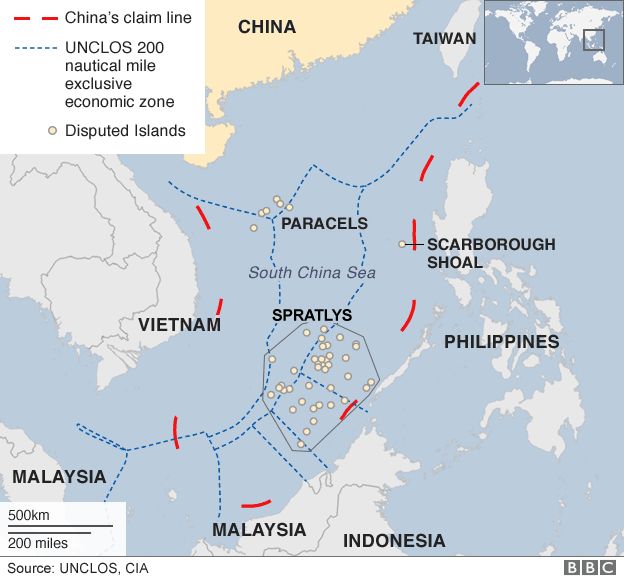
While China’s help is practically required with the NORK’s, it remains a serious threat elsewhere in the region–Taiwan and in the South China Sea especially.  The map below clearly shows the extent of the issue with the South China Sea as indicated by the dashed red line.

 South China Sea

China has already established–and fortified–at least three man-made islands amongst the Spratly Islands, complete with missile defense and runways.  The main issue with China’s claim here is the threat posed by the control of the seas.  The Strait of Malacca (not visible on the above map but would be off the lower left corner) is a very strategic waterway, control of which could seriously restrict, or threaten, trade–and oil–to many of our allies in the region.  Obviously, several other countries in the region have a claim, and probably a stronger one at that, to the Spratlys, notably, Malaysia, The Philippines, and Vietnam.  China’s dogged claim to this region presents a threat more to American allies than to the US itself but American interests are at stake as well, especially when it comes to trade and freedom of the seas.


Review of America’s War for the Greater Middle East

I just finished reading Andrew Bacevich’s latest book, America’s War for the Greater Middle East.  This is a very good survey of the United States’ role in the Middle East starting with the Shah’s demise in Iran in 1979 continuing to the present (2016). Bacevich does a nice job juxtaposing a reported rhetorical question of the Shah’s that seems to set, at least one of the themes, for the entire book: “What will you do [the US] if one day Iran will be in danger of collapsing? Do you have any choice?” The Shah supposedly asked this question as he saw “Iran performing a critical security function that the United States was unable or unwilling to perform itself.” Ironically, Bacevich ends with Iran as well in the fight against ISIS trying to re-establish some sense of security in the region (even though Iran has a totally different idea of “regional security.”  Iran wasn’t an American ally but they had effectively enlisted in the war against ISIS.

Bacevich also confronts several questions about America’s role in the Middle East, since today’s problems in the region are substantially greater than when the US got involved more than 30 years ago. Two main questions: “Why has the world’s mightiest military achieved so little even while itself absorbing very considerable losses and inflicting even greater damage on the subjects of America’s supposed beneficence?” And, “why in the face of such unsatisfactory outcomes has the United States refused to chart a different course?” An overriding theme to the answer to both questions: American hubris.

Bacevich isn’t afraid to pull any punches, either.  When it comes to why we got involved in Iraq under Bush:  “The US was intent on establishing the efficacy of preventive war; it was going to assert its prerogative of removing regimes it deemed odious, and it was seeking to reverse the practice of exempting the Islamic world from neo-liberal standards.”  Similarly, Obama doesn’t fare any better:  by electing Obama, “Americans once more entrusted the highest office in the land to a foreign policy neophyte”–and Bacevich’s analysis doesn’t get any better for Obama regarding Syria and the rise of ISIS.

Overall, this is a very good survey for anyone interested in America’s role in the Middle East over the the last 38 years.

Israel – and an emerging Arabian Entente?

In the last two weeks, a couple things have happened that one might think would really destabilize an already destabilized region:  First Israel launched a series of attacks on Syria, targeting the suburbs of Damascus.  The actual targets remain somewhat hazy but it appears the Israelis took out possibly a couple military bases and chemical munitions sites and then possibly, a base operated by the Iranian Republican Guards.  This was followed very shortly by President Donald Trump following through on a promise that several other recent presidents have made:  to recognize Jerusalem as Israel’s capital and move the US embassy to Jerusalem.  Each of the last few US Presidents have promised to do this but ultimately failed to follow through on this.

The obvious concern with these two anomalous events is that any attempt at peace between the Israelis and Palestinians would be shattered.  However, it is appearing that the Iranian threat might be more of a threat to regional stability than the Israeli-Palestinian issue.  This is obviously not what the Palestinians want to hear.  The immediate reaction from most every country in the world condemned Trump’s action–especially in the Arab world.  Even American allies in Europe were quick to denounce the move.

However, at the UN today, US Ambassador Nikki Haley, took on the regional instability issue and turned the tables on the Palestinian issue by introducing some dramatic evidence of Iranian malfeasance in the Arabian peninsula:  She produced missile fragments and debris from remnants of a missile the Houti rebels fired into Saudi Arabia–remnants of missiles manufactured in Iran.  Haley went on to indicate that US strategy towards Iran would be changing and focusing on the overall Iranian threat to the region, rather than simply focusing on the Iranian nuclear issue.

As for the Arab response to the recognition of Jerusalem as the capital of Israel and the US moving it’s embassy there, word is coming out that both the Saudis and the Egyptians gave the Trump administration their prior approval.  While spokesmen for both countries vociferously opposed Trump’s move, in private, it would appear that both countries recognize that it might be time to move on and focus on a more potent threat to the region.

The U.S., China, and North Korea – a Sobering Assessment

Just after yesterday’s posting on the US, China and North Korea I saw a posting from Herschel Campbell in this morning’s edition of The Hill.  Campbell’s article, The Time for doing nothing on North Korea is Over, offers a sobering assessment of what could  happen in the wake of a military confrontation.  It’s long been known that North Korea has thousands of artillery pieces essentially holding Seoul hostage.  At the same time, he proposed some similar ideas:  the possibility of a naval blockade of North Korea and the possibility of China undertaking a regime change in the North.  One thing I think everyone agrees on though, is that time is running out.